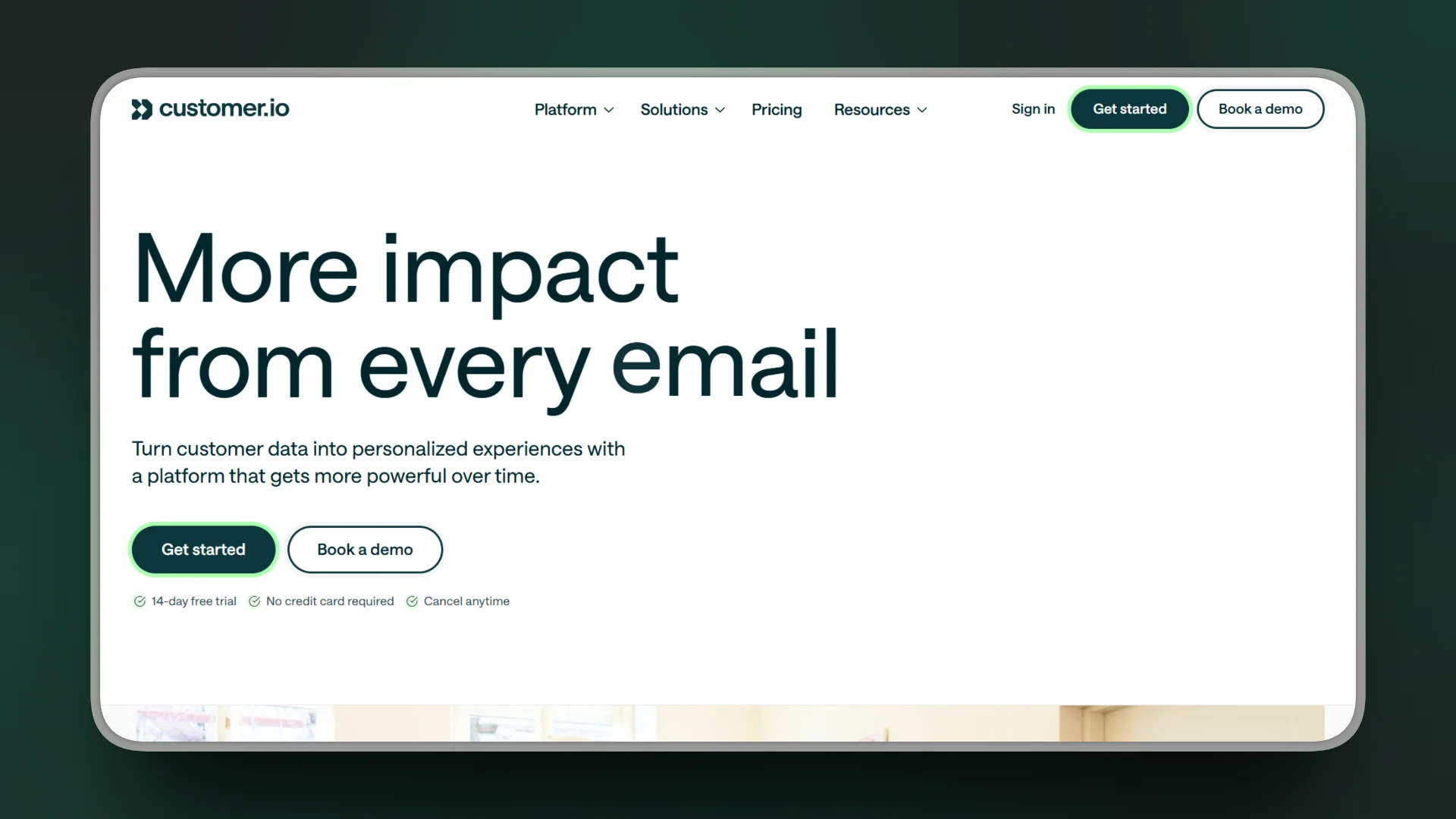
In September 2025, Customer.io's CEO Colin Nederkoorn announced the company had crossed $100M in annual recurring revenue, with more than 8,000 paying customers on the platform. For a company that started as a five-customer experiment in 2012, and was still sitting at roughly $70M ARR with 7,000 customers as recently as 2022, that's a meaningful jump in a short window.
But the ARR number isn't the interesting part. Plenty of martech companies have hit nine figures by pouring money into paid acquisition and then watching their expansion revenue quietly leak out the back door. What makes Customer.io worth studying is how it got there and specifically, what its retention numbers say about the quality of that growth.
The numbers tell you the same thing: existing customers are spending more with Customer.io over time. That's the opposite of what happens when growth is rented through paid ads. It's what happens when a company builds durable, compounding demand largely through content, product-led mechanics, and organic discovery.
That's the lens we're going to use for this case study, because it's the one most relevant if you're a B2B SaaS company trying to figure out whether organic, content-led growth actually shows up in the metrics that matter to your board.
The Pivot That Set Everything Up
Customer.io didn't start as a messaging platform. Co-founder Colin Nederkoorn's original idea was a more detailed web analytics tool, essentially as a “nice-to-have” but not urgent. Early customer feedback made it clear nobody was desperate for better analytics. What they wanted was a way to actually act on that behavioral data to reach the right customer, at the right moment, based on what that customer had actually done.
That pivot, from observing behavior to acting on it, is the foundational decision that everything else in this case study builds on. The team relaunched around automated, behavior-triggered messaging and validated it with an unglamorous but effective move: they sold a promise before the product could fully deliver on it, charging early adopters $10/month while manually writing queries behind the scenes to make the "automation" work. It's a classic Wizard-of-Oz MVP, and it bought them the runway to build the real thing while staying close enough to five paying customers to know exactly what to build next.
Before the product was even fully built, the founders were already doing something that would define the company's growth motion for the next decade: teaching. Nederkoorn taught himself conversion copywriting so he could show early prospects how to actually write messages that convert thus creating value with content before there was anything to sell. That instinct, lead with education, shows up again and again as the company scales.
The Channel Mix: Self-Serve Foundation, Enterprise Layer, Partner Multiplier
By the time Customer.io was approaching $100M ARR, its go-to-market had matured into a hybrid model that most SaaS companies eventually need but few build cleanly:
- Self-serve remains the primary acquisition gateway. The website functions as a genuine e-commerce motion for SMBs through tiered plans, transparent pricing, low-friction signup.
- Enterprise sales now drives the majority of new revenue. Following a 2025 upmarket push, roughly 60% of new ARR comes through a direct sales motion built for larger accounts that need custom security reviews, complex integrations, and formal SLAs.
- A 300+ agency and consultancy partner network accelerates international expansion, particularly in EMEA and APAC, where local privacy and compliance expertise matters more than a generic sales pitch.
- Product-led sales closes the loop. Usage data from 14-day trials triggers personalized outreach meaning the sales team isn't cold-calling; they're reaching out to accounts that have already shown intent through actual product behavior.
This is worth sitting with for a second: the enterprise motion didn't replace the self-serve/content engine, it was built on top of it. Self-serve and organic content generate the volume and the trial signups; product usage data tells sales who's worth calling; the partner network extends reach into markets that would be expensive to enter directly. Each layer makes the next one more efficient.
The Organic Engine: Why ~45% of Inbound Doesn't Come From Ads
Here's the number that matters most for this audience: organic search accounted for roughly 45% of Customer.io's inbound inquiries in 2025 organically, by the company's own reporting.That didn't happen by accident. It's the product of a deliberate hub-and-spoke content architecture:
Technical authority hubs. Deep, comprehensive documentation-adjacent content like liquid templating guides, API integration tutorials, behavioral segmentation walkthroughs establishes Customer.io as a credible technical authority. This content ranks for bottom-of-funnel, high-intent queries because it's written by and for the people actually doing the implementation work, not top-of-funnel generalist content chasing volume.
Competitor-alternative content. Rather than only ranking for generic category terms, Customer.io targets "switch" intent directly through content built around terms like "Mailchimp alternatives" or comparisons against Braze, capturing users who've already decided their current tool isn't working and are actively looking for what's next. This is paired with targeted paid LinkedIn and Google campaigns aimed at the same switcher intent, so organic and paid are reinforcing the same demand signal.
Dogfooded, behavior-triggered nurture. Instead of generic drip sequences, Customer.io uses its own product to segment prospects by industry like FinTech, EdTech, SaaS and deliver automated sequences that function as live product demos, triggered by actual behavior rather than a fixed day-3, day-7, day-14 cadence. The result: demo-to-deal conversion rates that outperform generic nurture flows, because the content a prospect receives is a direct reflection of what they've already shown interest in.
Omnichannel orchestration with fallback logic. The lifecycle doesn't live in a single channel. A sequence might start with email, escalate to SMS for time-sensitive moments, and use in-app or push messaging for real-time, high-intent interactions with channel fallback logic ensuring a message only escalates to a new channel if the previous one went unopened. Frequency capping and auto-suppression kick in the moment a prospect converts, which matters as much for brand trust as it does for deliverability.
Continuous incrementality testing. Campaigns are tied to specific conversion actions, not vanity metrics like opens or clicks. Holdout testing while deliberately excluding a small percentage of the audience from a campaign is used to measure the actual lift a message drives on retention and conversion, rather than assuming correlation is causation.
If you're building an organic strategy for a B2B SaaS product, this is close to a blueprint: technical authority content for bottom-of-funnel intent, switcher content for competitive displacement, and a lifecycle layer that treats every message as a data point to be tested, not a broadcast to be sent.
The Underrated Growth Lever: Free Tools as a Discoverability Engine
One part of Customer.io's organic footprint that doesn't get talked about enough is its library of small, free, single-purpose tools i.e. things like an EML file viewer, an email scrolling GIF generator, a placeholder image generator, a lorem ipsum generator built for email design, and a tool that calculates the carbon footprint of an email based on its size.
None of these tools are the product. None of them are going to close a deal on their own. But collectively, they do three things extremely well:
- They capture long-tail, high-intent search traffic from people already working inside the exact problem space Customer.io sells into someone searching "how to check what's inside an EML file" is, functionally, a marketer or developer already doing hands-on email work.
- They generate natural backlinks. Free utilities get bookmarked, shared in Slack channels, and linked from "best free marketing tools" roundups building link equity that's far harder to earn through a standard blog post.
- They function as always-on brand touchpoints for people who aren't ready to buy yet, which is exactly the audience a MOFU or even TOFU content strategy is supposed to nurture.
This is a genuinely underused GEO and SEO tactic. A single blog post competes for a ranking position and eventually goes stale. A useful, free, narrowly-scoped tool keeps earning organic and AI-citation value with almost no ongoing content maintenance, because it's solving a real, recurring problem rather than answering a single search query once.
The Infrastructure Choice: Why the Tech Stack Isn't a Footnote
It's easy to treat a company's website framework as an implementation detail irrelevant to a marketing case study. It isn't, and Customer.io's own site is a useful example of why.
Customer.io's site runs on Next.js, that is, the same modern React-based framework used by companies like Miro, Notion, Zapier, ClickUp, and Supademo, all of whom have made the same underlying bet: that fast, server-rendered pages paired with a flexible content layer (in Customer.io's case, paired with Sanity CMS) matter more for growth than they get credit for.
That combination matters for exactly the reasons this case study has been building toward:
- Speed is an SEO ranking factor and a GEO factor. Server-side rendering and static generation mean pages load faster, which both search engines and AI crawlers reward, and which reduces bounce rate on the exact technical content this company depends on for organic traffic.
- A structured, headless CMS lets content and engineering move independently. Marketing and content teams can ship new pages, comparison content, and landing pages without waiting on a developer for every change, which is what makes a hub-and-spoke content strategy operationally sustainable at scale rather than a one-time content sprint.
- Structured content is easier for AI systems to parse, cite, and summarize. As more discovery moves through LLM-driven answers rather than traditional search results pages, having content stored in a clean, structured format (rather than buried in a legacy CMS's inconsistent HTML) is a quiet but real advantage for AI visibility.
The companies converging on this same stack like Miro, Notion, Zapier, ClickUp, Supademo aren't a coincidence. They're all product-led, content-heavy, developer-adjacent businesses that depend on the same thing Customer.io depends on: technical content that ranks, loads fast, and can be produced at volume without bottlenecking on engineering.
The Organization Behind the Growth: Discipline, Not Luck
None of the above happens without an organization built to sustain it. Customer.io CMO Jason Lyman has been candid about the structure behind the company's ~30-person marketing team (inside a roughly 275-person company): three focused teams including product marketing, demand generation, and marketing growth, plus two centers of excellence in brand studio and marketing operations, built specifically to serve the dual self-serve and sales-led motions without the two stepping on each other.
Underneath that structure sits a discipline that's easy to state and hard to actually follow: hard KPIs (churn, ARR, logo retention) that the team treats as non-negotiable, paired with aspirational OKRs targeted at 85–90% completion rather than 100%, a framework explicitly designed to remove emotionally-driven prioritization from a marketing org, and to keep marketing, sales, and product tightly aligned rather than working from separate scorecards.
The Point That Matters Most for B2B SaaS Founders
If there's one piece of insight from inside Customer.io worth featuring on its own, it's this: traditional SEO's effectiveness is eroding as buyers increasingly rely on LLMs and AI-driven discovery tools, and marketers will need to shift toward optimizing positioning and content specifically for how AI systems consume and cite it, not just how search engines rank it.
That's coming from the CMO of a company that just crossed $100M ARR with organic search driving nearly half its inbound. It's not a rejection of organic strategy, it's an evolution of it. The hub-and-spoke content, the free tools, the structured Next.js and Sanity content architecture, all of it was already positioning Customer.io well for a world where AI systems, not just search engines, are the ones surfacing and summarizing a brand's authority. The companies that will keep winning organic-driven growth aren't the ones abandoning SEO; they're the ones treating GEO and AEO as the next layer of the same discipline, not a separate one.
Campaigns That Turned Authority Into Pipeline
A few specific campaigns show how Customer.io converted content authority into measurable revenue signal, rather than leaving it as brand awareness:
- The State of Messaging Automation (2025) report analyzed anonymized data from billions of messages to surface benchmark trends. It generated thousands of gated leads, drove a reported 30% rise in brand mentions across major tech outlets, and produced a steady stream of "snackable" statistics that fueled social distribution and earned backlinks long after the report itself was published.
- Migration Made Easy, launched in late 2024, targeted users of specific competitors going through price increases or consolidation, pairing a dedicated landing page and ROI calculator with white-glove migration support. It lifted competitive win rates by a reported 25% over six months which stands as a proof that reducing switching friction with content and tooling converts better than a generic "why we're better" pitch.
- The Human Logic video series, featuring growth leaders from companies like Notion and Reddit, generated over 2 million impressions and leaned entirely on social proof and storytelling rather than product pitching thus reinforcing enterprise credibility further down the funnel.
What This Means If You're Building a B2B SaaS Growth Motion
Pull this case study apart and a consistent pattern shows up at every layer: acquisition, retention, and expansion were never treated as separate problems solved by separate teams working from separate playbooks. The same instinct that drove pre-launch educational content in 2012 i.e. teach first, sell second shows up in 2025 in the technical documentation hubs, the free tools, and the CMO's own framing of where content strategy needs to go next.
The 117–120% NRR range is the scoreboard. The organic engine consisting of content, free tools, product-led lifecycle messaging, and infrastructure built to support all of it at scale, is what actually put the points on the board.