

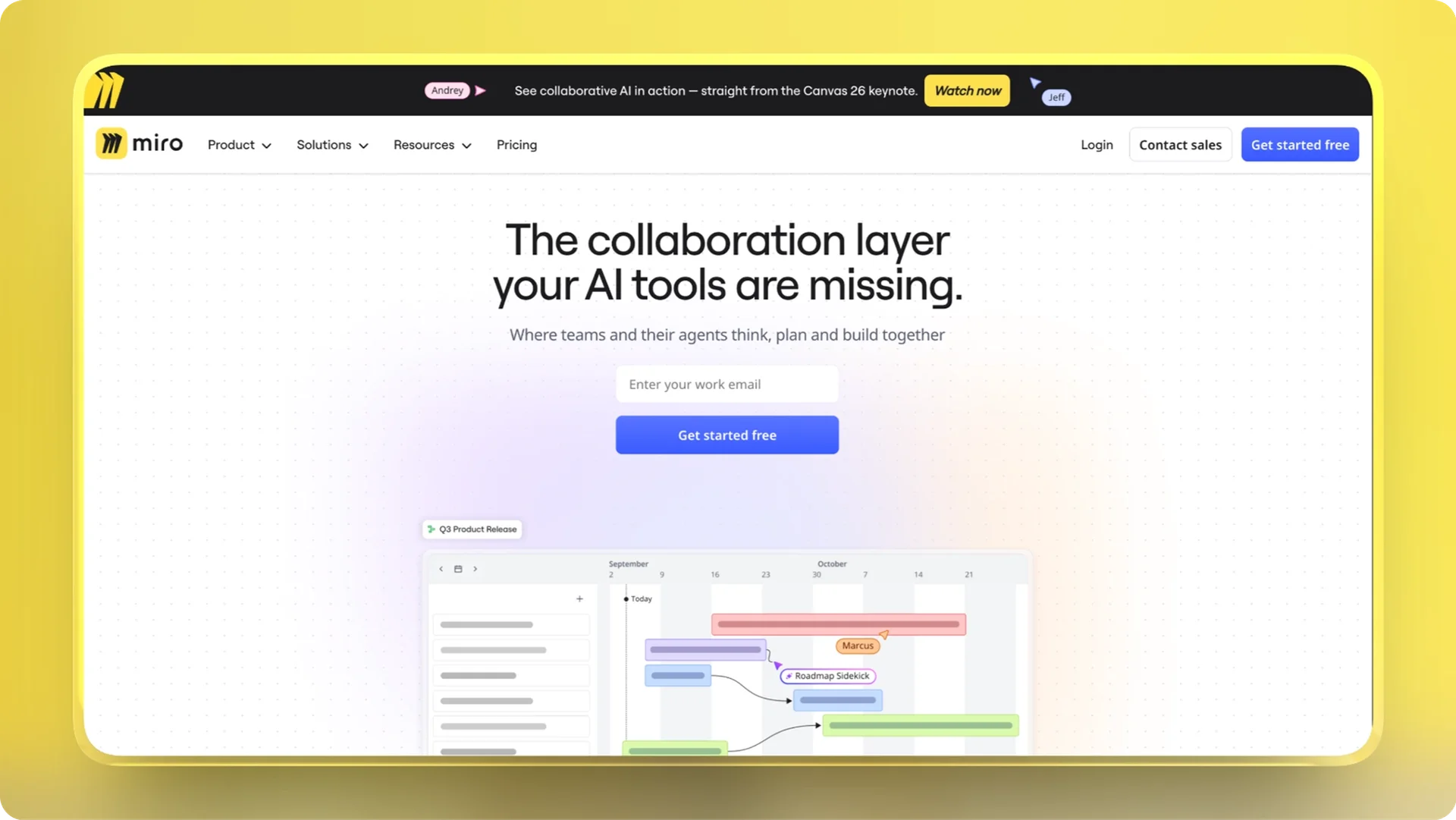
In 2011, Andrey Khusid and Oleg Shardin built a simple online whiteboard called RealtimeBoard out of Perm, Russia.
It wasn't a category-defining insight or a billion-dollar vision. It was, in their own words, a tool for distributed teams who were tired of trying to collaborate through PowerPoint slides and email chains.
Fast forward to 2025: Miro, the company RealtimeBoard became, crossed 50 million users, achieved decacorn status at a $17.5B+ valuation, and was embedded in the workflows of 99% of Fortune 100 companies.
And here's the part that should make every B2B SaaS founder take notes:
They didn't buy their way there.
The majority of Miro's growth came from organic channels like product virality, template-led SEO, community-driven content, and a go-to-market strategy so tightly woven into the product itself that acquisition and retention became the same motion.
This is the story of how they did it. And more importantly, what the mechanics looked like under the hood because the lessons here are for every B2B SaaS product that wants to build a compounding organic growth engine instead of renting attention forever.
Part 1: The Foundation- Why PLG and Organic Growth Are the Same Bet
Before we get into tactics, there's a mental model worth establishing.
Most SaaS companies treat SEO as a marketing function and product-led growth as a product function. They run in parallel, occasionally intersecting. Miro treated them as the same function.
Luis Rodriguez, who led organic growth at Miro for over a decade and built their in-house Answer Engine Optimization framework, articulated this clearly: "The product should tell you where the demand is."
What he meant was that the best organic growth strategies aren't discovered in keyword research tools. They're discovered by watching what users actually do with your product. This includes what they search for, what they share, what they build and then creating content and experiences that mirror that intent at scale.
This reframing matters enormously. It's why Miro's SEO motion looks nothing like a traditional SaaS content blog. It's a product-adjacent content system. Every page, template, and resource is designed not just to rank, but to pull users into the product experience immediately.
That's the foundation everything else sits on.
Part 2: The Freemium Engine- Value Before the Ask
Miro's first and most important organic growth move wasn't a content strategy. It was a pricing decision.
The freemium model that gives users real value before asking for money, became the engine that powered every other growth lever.
Users could sign up, invite unlimited team members, and start collaborating on boards without touching a credit card. The logic was simple but counterintuitive for the SaaS world of the early 2010s: get users to the "aha moment" before the friction of a purchase decision.
The results validated the bet. Freemium drove over 60% of new user acquisitions. And because collaboration is inherently multi-player, every free user who invited a teammate was a distribution event. Every shared board link was an acquisition channel.
This is what they call a "PLG feedback loop" where the product's collaborative nature makes growth a byproduct of usage, not a separate activity. Viral loops weren't bolted on as a growth hack. They were built into the core mechanic of what Miro does.
The invite flow, the shareable board link, the real-time collaboration that made you want to show someone. All of it generated organic reach without a dollar of paid spend.
By 2025, AI-driven onboarding had further improved free-to-paid conversion rates by roughly 15%, reducing CAC and compressing the time from signup to value. New users were reaching their "aha moment" faster than ever.
The lesson for B2B SaaS founders: Your freemium tier is your organic distribution channel. Design it like one. Every feature you gate, ask whether gating it kills the sharing behavior that would have brought you three more users for free.
This is what they call a "PLG feedback loop" where the product's collaborative nature makes growth a byproduct of usage, not a separate activity. Viral loops weren't bolted on as a growth hack. They were built into the core mechanic of what Miro does.
The invite flow, the shareable board link, the real-time collaboration that made you want to show someone. All of it generated organic reach without a dollar of paid spend.
By 2025, AI-driven onboarding had further improved free-to-paid conversion rates by roughly 15%, reducing CAC and compressing the time from signup to value. New users were reaching their "aha moment" faster than ever.
The lesson for B2B SaaS founders: Your freemium tier is your organic distribution channel. Design it like one. Every feature you gate, ask whether gating it kills the sharing behavior that would have brought you three more users for free.
Part 3: The Template Flywheel- SEO Meets Product Adoption
Here's where Miro's organic strategy gets genuinely brilliant.
Templates were not just an onboarding convenience. They became Miro's single most powerful organic growth asset.
Think about the search intent behind queries like:
- "brainstorming template"
- "UX research plan template"
- "product roadmap template"
- "retrospective template"
- "mind map maker"
- "flowchart creator"
These aren't informational searches. They're people with an immediate, acute need. They want to do something right now.
Miro's content team understood this distinction and built accordingly.
Their template pages weren't traditional SEO content. They were interactive product experiences dressed as landing pages. A user searching for "brainstorming template" would land on a Miro page, see a real, usable template, and be able to start editing it inside Miro before they'd even consciously decided to sign up.
The genius of this approach is that it collapsed the funnel. The typical SaaS funnel looks like: discover → research → sign up → onboard → get value. Miro's template pages made it: discover → immediately get value → incidentally sign up.
The Miroverse, Miro's community-driven template gallery housing 3,000+ user-created templates, extended this further. It created a content supply chain where the community built the content, and Miro got the SEO benefit.
Miro's overall SEO operation targets 5,000+ high-intent keywords across agile workflows, mind mapping, strategic planning, and visual collaboration verticals. Not vanity traffic, these are intent-matched traffic that converts.
The lesson for B2B SaaS founders: Map your highest-intent keyword clusters to product experiences, not blog posts. If someone searches for "retrospective template," the answer isn't a 1,500-word guide on how to run retrospectives. The answer is a template they can use in your product, right now, for free.
See how Ehroo helps companies
Book a personalized call with our RevOps expert and find the right solution for your growth goals.
Part 4: The Infrastructure Problem Most SaaS Companies Ignore
One of the major reasons why most SaaS companies never build what Miro built, is infrastructure.
The most common consistent failure patterns in SaaS organic growth is that companies don't fully own their acquisition channels. They outsource control to platforms that were never designed to scale with them.
Many SaaS companies rely on Webflow, Framer, or WordPress. These platforms are excellent for landing pages and basic marketing websites. But they become hard ceilings when you want to build sophisticated, SEO-driven growth engines.
The highest-leverage organic growth assets aren't blog posts. They're programmatic, dynamic, deeply integrated with the product. Things like:
- Migration pages: capturing users leaving competitors
- Comparison pages: owning decision-stage searches
- Integration directories: ranking for "[Your product] + [Tool]" queries
- Workflow libraries: covering every use case your product supports
- Template galleries; Miro's exact playbook, at scale
- Free tools and calculators: high-intent, high-conversion utility content
- Programmatic SEO pages: generating thousands of targeted pages from structured data
These assets are significantly harder to build and maintain on no-code website builders. You hit limits fast in page structure, dynamic content generation, URL architecture, and the ability to embed live product experiences.
That's exactly why category leaders like Zapier, Notion, ClickUp, and N8n invest heavily in engineering-led growth infrastructure. They build on frameworks like Next.js, Astro, and Nuxt combined with headless CMS platforms like Sanity, Payload CMS, and Strapi giving them the ability to generate complex, targeted growth assets at scale without hitting platform walls.
Miro's template infrastructure is a direct product of this kind of engineering investment. It's a custom-built growth system where engineering, SEO strategy, and product are the same team working from the same codebase.
This is the gap most SaaS founders don't see until they're already behind. You can't template-SEO your way to 2.6 million monthly visits using a drag-and-drop builder. At a certain scale, organic growth becomes an engineering problem as much as a marketing one.
The lesson for B2B SaaS founders: Audit your infrastructure before you audit your content. If your marketing site can't support programmatic page generation, dynamic product embeds, or custom URL architectures your organic ceiling is lower than you think. The companies winning at scale didn't just create better content. They built better systems to create and serve it.
Part 5: Comparison Content- Capturing the Buyers Who Are Ready to Decide
Templates and tool pages capture top-of-funnel demand. Miro's comparison content captures the bottom.
Pages like "Miro vs Lucidchart" and "Best Whiteboard Tools" aren't educational content. They're decision-support content. The person who searches "Miro vs Lucidchart" is not browsing, they're choosing and Miro made sure that when that person searched, they found a page Miro controlled.
This is a critical strategic move that most B2B SaaS companies either ignore or execute poorly. They write comparison content that's so balanced it doesn't convert anyone. Miro's comparison pages are built to convert. It includes feature breakdowns, customer testimonials, and clear positioning that answers the user's real question: "Which one should I pick?"
The combination of Miro's template content (high volume, top-funnel) and comparison content (lower volume, high-intent, high-conversion) created a full-funnel organic search presence. They weren't chasing traffic. They were engineering a content pipeline that matched searcher intent at every stage of the buying journey.
Part 6: The AEO Framework- Miro's Strategy for the AI Search Era
This is where the story gets most relevant for 2025 and beyond.
Miro built their in-house Answer Engine Optimization (AEO) framework from scratch, positioning Miro not just for traditional search rankings, but for visibility inside AI-generated answers on platforms like ChatGPT, Perplexity, and Google's AI Overviews.
The insight driving this work was simple but profound: search behavior is changing. Users increasingly get their answers without ever clicking through to a website. If Miro's content isn't structured to be cited by AI systems, the traffic channel that built the company could erode underneath them.
Their AEO framework focused on ensuring Miro's content was not just rankable, but citable i.e. structured in ways that made it easy for large language models to extract, attribute, and surface.
This means:
- Clear, definitive answers to specific questions (not just keyword-stuffed prose)
- Structured data and schema markup that AI crawlers can parse
- Authoritative depth that signals to AI systems "this is the source of truth"
- Brand presence across the broader content ecosystem, not just owned channels
On top of it Miro’s team used platforms to measure brand visibility across all search prompts, not just tracking individual keyword rankings but understanding how present Miro was as a brand across the entire search intent landscape.
This is a fundamentally different way of measuring organic success. Not "did we rank #1 for this keyword?" but "when someone searches anything related to visual collaboration, how often does Miro appear in the answer?"
Miro's priorities for staying relevant in the AI search era:
- Invest in data and technical foundation first- quality data underpins all growth engines
- Question every role, scope, and process- rigid job definitions kill AI-era agility
- Adopt a 360° content approach- feed multiple channels with consistent messaging, not just blog posts
The message is clear: Miro isn't treating AI search as a threat to navigate around. They're treating it as the next distribution channel to own.
Part 6: The Community Flywheel- Why Miroverse Was a Strategic Masterstroke
Let's revisit Miroverse.
Most SaaS companies think about community as a retention play. Keep customers engaged, reduce churn, build loyalty. Miro built Miroverse as an acquisition engine first.
Miro created a platform where power users could publish templates. Those templates got indexed by search engines. New users searching for specific templates would land on Miroverse pages, encounter a template built by a real user solving a real problem, and sign up to use it.
The community was creating content as well as distribution. The distribution was creating new users. New users became community members and thus, the flywheel spun.
The 2024 Miroverse Creator Challenge supercharged this flywheel deliberately. Miro rewarded users for building and sharing templates, partnered with influencers on YouTube and TikTok to amplify the challenge, and saw template submissions grow 150%. The community didn't just sustain itself, it was engineered to accelerate.
This is community-led growth at its best. It's a content production system where your most engaged users generate your most powerful organic assets, and they feel good doing it because they're building their own reputation in the process.
The lesson for B2B SaaS founders: Your power users are an underutilized content team. Build a platform that lets them create and structure it so that creation benefits them (visibility, recognition) while benefiting you (SEO, distribution, social proof).
Part 7: The GTM Machine- How PLG Became Enterprise
Here's the thing about organic growth that most people miss: it's not just a top-of-funnel play.
Miro's organic motion like freemium, templates, community, SEO, built the initial user base. But that user base became the sales force for enterprise expansion.
The pattern is what enterprise SaaS teams call "land and expand." One designer at a Fortune 500 company signs up on the free tier. They build a board and share it with their product team. The product team invites the engineering team. Before the enterprise sales team has made a single outbound call, Miro has 40 users inside the account.
Now the enterprise sales conversation changes entirely. It's not "would you like to try Miro?" It's "your team is already using Miro, let's talk about an enterprise agreement."
By 2025, enterprise revenue represented approximately 55% of Miro's ARR, which was on track to exceed $1.2 billion by FY2026. Channel-led enterprise deals through consulting partners like Accenture and Deloitte grew roughly 40% year-over-year.
None of this happened despite the organic-first strategy. It happened because of it. The freemium and template SEO motion seeded enterprise accounts at scale. The sales team just closed what organic growth had already started.
This is the compounding advantage of organic: it doesn't just reduce CAC for SMB acquisition. It pre-sells enterprise.
Part 8: The Campaign Layer- How Brand Amplified What Organic Built
Organic growth built Miro's foundation. Brand campaigns amplified it.
The 2024 "The Ways We Work" campaign marked Miro's shift from collaboration niche to enterprise operating system. In mid-2025, "Innovation at the Speed of Now" tied the platform directly to AI-driven product velocity, using high-production case studies featuring Nike and Cisco to claim a 40% reduction in product development cycles. The campaign generated 500M+ impressions and a 20% uptick in enterprise inquiries within 90 days.
The "Work Reimagined" campaign in 2025 addressed a specific retention risk i.e. remote meeting fatigue by reframing Miro as the antidote to yet another video call. The asynchronous collaboration angle helped preserve a ~95% customer retention rate during a broader SaaS churn period.
What's worth noting here is that Miro's campaigns were always connected to measurable organic outcomes. The Miroverse Creator Challenge drove template supply, which drove SEO. The enterprise campaigns drove brand search volume. Brand search is itself an organic signal that compounds over time.
They weren't running brand spend and organic spend as separate budget lines with separate goals. The entire go-to-market was designed to reinforce itself.
Part 9: The Metrics That Actually Matter
There’s no bigger trap than vanity metrics.
Traffic. Impressions. Rankings. These are working metrics, not success metrics. They're useful for diagnosing the health of your organic engine, but they're not what you should be reporting to your CEO or board.
The metrics that matter for an organic growth program inside a SaaS company:
Business metrics (the scoreboard):
- Revenue influenced by organic channels
- Free-to-paid conversion rate from organic traffic
- Net Revenue Retention among organically acquired users
- New enterprise accounts sourced from organic-led "land"
Working metrics (the dashboard):
- Brand visibility across category search intent (not just individual keywords)
- Return user rate from organic traffic
- Template engagement and sharing rates
- Time-to-first-value for organic signups
Miro's team also used brand visibility measurement tools to track how present Miro was across all search prompts in their category. In an AI search world where zero-click answers are the norm, this kind of brand presence measurement becomes even more critical. You need to know if AI systems are recommending you, not just if you're ranking on page one.
Part 10: What This Means for You (The Part Founders Actually Need)
Miro's story isn't a story about a whiteboard company that got lucky with remote work tailwinds.
It's a story about a company that built an organic growth system with compounding properties where each part fed the next, and where scale didn't require proportional spend.
Here's the framework distilled:
The Miro Organic Growth Stack:
- Freemium as distribution: Freemium is your organic reach mechanism when built around a collaborative, multi-player product.
- Intent-matched content: Don't write blog posts about problems. Build product experiences that solve them. Templates, tools, interactive pages. Meet the user's intent with a product moment, not an article.
- Community as content supply chain: Your power users will build your best organic assets if you give them a platform and a reason. Miroverse is a 3,000-template SEO library Miro didn't have to write.
- Comparison content at the bottom: Own the searches that happen right before someone buys. "vs" pages, "best [category]" pages, "alternative to" pages. These are low volume, high conviction, high conversion.
- AEO alongside SEO: Structure your content to be citable by AI systems, not just crawlable by search bots. The answer layer is the new first page.
- Measure brand visibility, not just rankings: In an AI search world, the question isn't "did we rank?" It's "when someone asks an AI about visual collaboration, does our brand appear in the answer?"
- Let organic seed the enterprise motion: The PLG flywheel plants Miro inside accounts before the sales team arrives. Organic growth isn't just a SMB play. It's the most effective enterprise SDR you'll ever hire.
The Uncomfortable Truth About Organic Growth
Here's the thing that doesn't make it into most case studies about Miro.
This took time.
Miro was founded in 2011. They hit 10 million users in 2020, nine years later. The template library, the community flywheel, the SEO infrastructure, none of it happened in a quarter. It compounded over years of consistent, intentional investment.
The founders who win with organic growth are the ones who understand what they're actually building an asset. One that appreciates over time, doesn't switch off when the budget gets cut, and creates defensible competitive advantages that can't be replicated by a competitor who shows up late with a larger paid budget.
Organic growth, done right, can generate 30-40% of a company's revenue as a primary engine.
But only if you build it like an engine with the right metrics, the right team structure (AI-first, data-driven, cross-functional), and the patience to let compound interest do its job.