
Notion reached a $10 billion valuation in its October 2021 Series C round and by late 2025 was doing over $600 million in annual recurring revenue with 100+ million users, all without spending a meaningful dollar on paid advertising. Instead of buying growth, Notion engineered three self-reinforcing organic loops: a template viral loop (free, user-made templates that spread like branded case studies), a collaborative viral loop (every teammate invited to a workspace becomes a new user), and an unmanaged-but-supported community ecosystem (Ambassadors, subreddits, YouTube tutorials) that did marketing, support, and sales for free.
This case study breaks down their exact playbook with the numbers, the near-death moment that forced the strategy, and the playbook you can apply to your own B2B or AI SaaS product.
Two Broke Founders, a Kyoto Apartment, and a Failed Startup
Picture this: two guys in a cramped Kyoto apartment, eating instant noodles because it's the cheapest place they can afford to live because their startup is about to run out of money for the fourth time.
That was Ivan Zhao and Simon Last in 2015.
Notion wasn't an overnight unicorn. Zhao and Last had already tried and failed with an earlier no-code product. When they attempted their first version of Notion, the product was buggy, confusing, and the company was burning through its last dollars. At one point, Zhao borrowed money from his mother just to keep the lights on. There was no product-market fit in sight, and Silicon Valley wasn't exactly lining up outside their door.
So they made a decision that looked, from the outside, like business suicide: they cut the team down, moved to Kyoto where the cost of living let their remaining cash stretch further and rebuilt the product from scratch.
This is the part most growth breakdowns skip past, but it's the most important strategic fact in the entire story: Notion didn't choose organic growth because it was safe. They were forced into it because they had no other option. They didn't have the cash for Facebook ads, a sales team, or a growth-hacking budget. That constraint is what pushed them toward building a product people would share on their own, and it's the single biggest lesson for any founder reading this with a limited marketing budget.
Notion 1.0 launched in August 2016 and was named Product Hunt's Product of the Day, Week, and Month. It put Notion in front of exactly the audience whose word-of-mouth would define the company's next decade: productivity nerds, indie hackers, and early-adopter power users. Notion 2.0 followed in 2018, again topping Product Hunt, and that's when the flywheel truly started turning.
The Numbers: From $3M ARR to a Public-Company-Grade Multiple
Before we get into how, here's the what because the trajectory itself is the case study.
Two things jump out here for founders:
- Revenue grew roughly 19x in four years (2021–2025) while the valuation moved less than 10%. Notion didn't "grow into" its $10B price tag by raising more money at a higher number, it simply kept executing until the revenue caught up. That's a very different discipline than the "raise bigger, spend bigger" playbook most VC-backed SaaS companies default to.
- Total lifetime funding raised: roughly $343 million. At $600M in ARR, Notion now generates more in a single year than it has raised across its entire company history. That's the return on refusing to buy growth.
Why Notion Refused to Buy Its Growth
Most SaaS companies at Notion's early stage lean hard on paid acquisition: Facebook and Google ads, SEO-driven keyword buying, aggressive outbound sales teams, funnel optimization tools. It's the default playbook because it's fast, predictable, and VCs know how to model it.
Notion couldn't do any of that because they didn't have the cash. But instead of treating this as a handicap, the founders treated it as the actual strategy: build a movement of evangelists, not a database of leads.
That meant asking a different question than most SaaS teams ask. Instead of "how do we get more signups," Notion asked: "how do we get our most obsessed users to bring the next 10 users with them, for free?"
The answer became a three-part organic growth engine that's since become one of the most studied case studies in product-led growth (PLG).
The Three-Part Viral Growth Framework That Replaced Paid Ads
1. The Template Viral Loop As a Growth Lever
Notion's earliest power users weren't just using the product, they were building things inside it and showing those things off. Student dashboards, habit trackers, content calendars, personal CRMs, entire "second brain" systems.
Instead of treating this as noise, Notion made every workspace shareable in one click and, critically, they never monetized it. No paywall on templates, no "pro tier to share your setup." That decision turned every enthusiastic user into an unpaid content creator.
The result: tens of thousands of free, user-generated templates now live in Notion's community gallery. Each one functions as a mini case study, a proof, in a real workflow, that Notion can solve a specific, relatable problem. That's a fundamentally different kind of marketing asset than an ad: it's not "buy our software," it's "here's exactly how I solved this problem, and you can copy it in one click."
Why it worked: Templates don't sell the tool, they sell the outcome. A prospective user doesn't see a landing page claiming Notion is flexible; they see an actual finished product they can use in 60 seconds. That's authentic, problem-driven word of mouth that no ad copy can replicate.
2. Collaborative Viral Loops Inside Teams
Most productivity tools of Notion's era like Evernote, Todoist, even early versions of competitors were built for solo use first, teams second. Notion inverted that from day one: it was designed as a collaborative workspace, which meant every new user invited a wave of other new users just by doing their job.
Here's the mechanism:
When someone who built their team's entire knowledge base in Notion changes jobs, they don't quietly stop using it. Instead, they introduce it at the new company. This is the mechanism behind what's sometimes called Notion's B2C2B motion: an individual falls in love with the product on their own time, brings it into their team, and the team eventually becomes a paying enterprise account. Rachel Hepworth, Notion's CMO (previously of Slack and LinkedIn), has described this exact dynamic: the personal, free usage builds the buzz, and that buzz trickles down into B2B revenue through land-and-expand.
3. Organic Community Ecosystems (Left Alone, Not Locked Down)
The third loop is the most counterintuitive for most marketing teams: Notion largely lets its community run itself.
Rather than trying to own or centrally manage every fan community, Notion let independent groups form organically on Reddit, Discord, YouTube, TikTok, Facebook, and even Etsy (where creators sell Notion template packs). The official Notion subreddit alone has grown past 400,000 members which operates as self-organizing, self-moderating, and doing more organic top-of-funnel work than most paid campaigns ever could.
Notion's role wasn't to control this. It was to support it through the Notion Ambassador program. Ambassadors get early access to features, funding for community events, and official recognition, and in exchange they moderate groups, create tutorials, run local meetups, and enforce a shared code of conduct without being on Notion's payroll. Notion doesn't own these communities; it publishes a directory of them and lets fellow community members lead.
Camille Ricketts, who led Notion's early marketing, has spoken about hiring people who were themselves already deep in the fan ecosystem rather than traditional marketing hires. The philosophy was simple: your superfans already know how to talk to your next users better than your marketing department does. Get out of their way, then hand them a megaphone.
The Night Notion's Servers Couldn't Keep Up With TikTok
In January 2021, a wave of TikTok creators started posting "get organized with me" videos showing off their Notion setups with none of it paid or coordinated with the company. The videos went viral fast enough that Notion's own infrastructure couldn't keep pace with the signup surge.
The company's response tells you everything about how seriously they took this channel: Notion paused new feature development for roughly six months to rebuild its backend so it could handle the load. That's a company treating an unpaid, organic viral moment with the same urgency most SaaS companies reserve for a funded paid-acquisition campaign because, functionally, it was worth more.
By late 2021, Notion had reached roughly 20 million users with 95% organic growth, meaning the overwhelming majority of new signups came from direct traffic, search, and referral rather than any paid channel.
The Churn Paradox: Why Losing Users Can Grow Your Company
Here's a number that would send most SaaS founders into a board-meeting panic: Notion's reported annual churn rate has run around 31%.
On paper, that looks bad. In practice, it's part of the growth engine because a large share of that churn isn't "this product failed me," it's "I changed jobs." A user who built their entire personal workflow in Notion doesn't abandon it when they switch companies; they bring it with them and introduce it to a new team. Each "churned" user becomes a potential new acquisition point at a different organization, at zero additional acquisition cost.
This is the kind of nuance most churn dashboards can't capture, and it's a genuinely useful mental model for any B2B or AI SaaS founder evaluating whether a "high" churn number is actually a red flag or a hidden distribution channel.
Capital Efficiency: What Notion Spent vs. What It Got
In 2022, Notion's total marketing spend was reported at roughly $7 million while direct competitors in the same category reportedly spent more than twice that on paid digital ads alone in the same period.
That gap is the whole thesis of this case study in one comparison. Notion wasn't out-performing its competitors because organic is free, it takes real investment in product, community programs, ambassador support, and content. It was out-executing them on efficiency: every dollar spent on community infrastructure and product experience kept compounding through loops that didn't decay the way paid campaigns do. An ad stops working the moment you stop paying for it. A template that ranks on Google or gets duplicated 50,000 times keeps working for years.
The Notion Playbook: What B2B and AI SaaS Founders Should Actually Steal
You don't need Notion's user base to apply Notion's mechanics. Here's the transferable version:
1. Build something inside your product that's worth sharing, then make sharing free. If your product only produces private, internal output, you have no viral surface area. Ask what your power users are already creating inside your tool (dashboards, workflows, reports, configs, prompts) and make that shareable in one click. Never paywall the sharing mechanism itself.
2. Design for teams, not individuals even if you start B2C. A tool that gets more valuable as more people join it grows itself. If your AI SaaS product is built for solo use only, you're leaving your strongest growth lever on the table.
3. Treat high "churn" as a data problem before you treat it as a failure. Segment your churn. If a meaningful share is coming from users changing roles or companies rather than abandoning the product, you may be looking at a distribution mechanism in disguise, not a retention crisis.
4. Don't try to own your community, support it. Trying to force every fan conversation into your official Slack or Discord kills the authenticity that makes community-led growth work. Publish a directory, offer resources and recognition, and let a structured ambassador program formalize the relationship without controlling the message.
5. Hire the community into the company. Your most credible next marketing hire may already be running a fan account, YouTube channel, or newsletter about your product. They understand your users' language better than any outside agency ever will on day one.
6. Let product-market signals, not fundraising pressure, set your growth pace. Notion wasn't first to market and didn't out-fund its category. It waited for real product-market fit before raising its Series A, and it let revenue catch up to its valuation for four straight years rather than chasing a bigger number. That discipline is rare, and it's exactly why the story holds up under scrutiny years later.
The best place to add this is after "The Three-Part Viral Growth Framework That Replaced Paid Ads" and before "The Real Takeaway" (or immediately before "The Notion Playbook"). It naturally bridges what Notion built with why most SaaS companies fail to replicate it.
Here's a section that matches the tone of your case study.
The Mistake Most SaaS Companies Make: Beautiful Websites, No Growth Levers
One of the biggest reasons companies fail to replicate Notion's organic growth isn't the product. It's the technology stack behind their marketing website.
Most SaaS companies launch on Webflow, Framer, or WordPress. They're excellent for shipping landing pages quickly, publishing blogs, and validating an early product. But they become increasingly limiting once organic growth depends on building products rather than pages.
That's exactly what made Notion's growth different.
Notion didn't just publish SEO content. It built assets people actually wanted to use and share. Templates weren't content marketing. They were product experiences that solved real problems, ranked in search, got shared across social media, and continuously brought new users into the ecosystem.
The same pattern exists across today's category leaders.
Companies like ClickUp, Zapier, Miro, Canva, Cloudflare, and N8n don't rely only on landing pages or blog posts. They build scalable growth levers such as:
- Template libraries
- Integration directories
- Migration pages
- Comparison pages
- Workflow libraries
- Free AI tools
- Interactive calculators
- Programmatic SEO pages
- Product-led utilities that generate organic demand
Each of these becomes a compounding acquisition channel. Instead of publishing another article every week, they're shipping assets that attract traffic, backlinks, shares, and users for years.
This is also why many of the fastest-growing SaaS companies eventually move beyond traditional website builders. While platforms like WordPress, Webflow, and Framer are excellent CMSs for marketing sites, they weren't designed to support complex, engineering-led growth systems at scale.
Modern SaaS companies increasingly combine frameworks like Next.js, Astro, or Nuxt with headless CMS platforms such as Sanity, Payload CMS, Strapi, Directus, or DatoCMS. That architecture gives growth, engineering, SEO, and product teams the flexibility to build interactive acquisition assets that simply aren't practical on traditional no-code platforms.
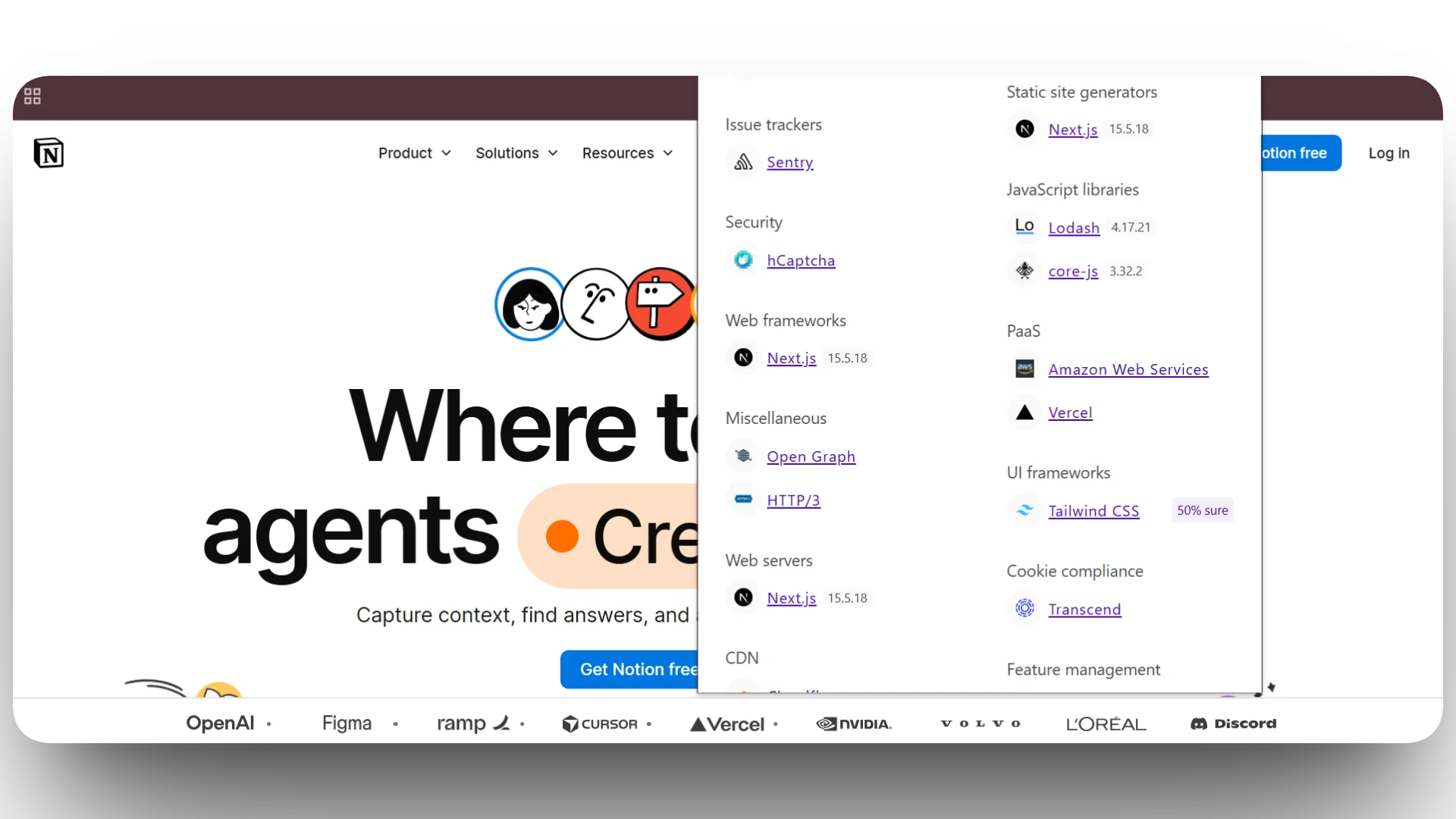
The lesson isn't that Webflow, Framer, or WordPress are bad products. They're outstanding for what they were built to do.
The mistake is assuming a marketing website is the same thing as an organic growth engine.
The companies winning organic search today aren't just publishing more content. They're building software that markets itself. Notion's template gallery is one example. Canva's templates, Cloudflare's free tools, Zapier's integration pages, and Miro's collaborative templates all follow the same principle.
The biggest organic growth opportunities rarely come from another landing page. They come from building growth levers that competitors can't easily copy.
The Real Takeaway
Notion's story isn't "don't run ads." It's that organic growth, done properly, turns into a great compounding asset. Every template, every ambassador, every piece of community content Notion invested in years ago is still generating signups today, at zero marginal cost. A paid campaign from the same year is long since switched off.
That's the entire argument for organic-first growth, stated in one company's balance sheet: $343 million raised across a company's entire lifetime, against $600 million generated in a single year, powered by loops built once and left to compound.