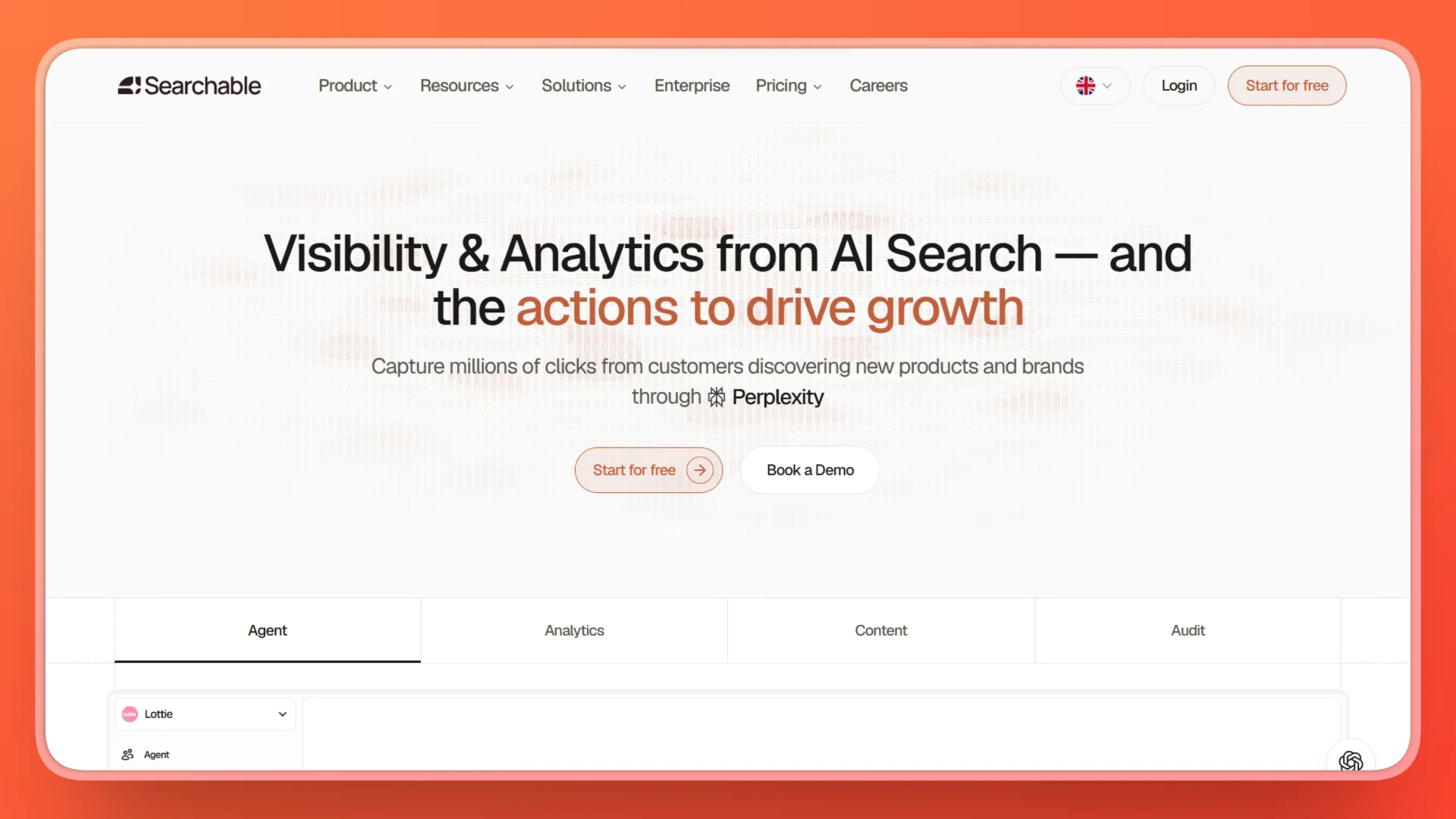
Searchable, the AI search visibility platform founded by Chris Donnelly, Sam Hogan, and Arya Nagabhyru, went from a free beta launch in November 2025 to $2M+ ARR by mid-May 2026 i.e. roughly four months after opening paid accounts. It closed that stretch by signing 500+ paying customers, converting 11 enterprise accounts off competing AEO platforms, and raising $14M at an $85M valuation led by Headline, the same fund that backed Semrush before its $1.9B acquisition by Adobe.
The growth was almost entirely organic, powered by founder-led LinkedIn thought leadership, a Product-Led Growth loop built around its free beta, and a deliberately high-effort, AEO-optimized content strategy that stands as the same playbook the platform sells to its own customers.
This is the story of how they did it and the specific, repeatable strategies buried inside it.
The 100-Day Sprint That Started It
In 2025, Chris Donnelly wasn't a first-time founder looking for an idea. He'd already built and sold Verb Brands, a luxury digital agency, for eight figures (reported at £18.5M / $25M to Croud in 2021). He'd scaled Lottie, a UK eldercare platform, to a nine-figure valuation. His Creator Accelerator had generated close to eight figures in revenue in its first year alone.
What he didn't have was a technical co-founder, until he flew to San Francisco specifically to find one. There, he teamed up with Sam Hogan and Arya Nagabhyru, and the three of them spent 100 days building what they called an "Autonomous SEO and AEO Growth Engineer" that functioned as an AI agent designed to handle the full marketing workflow, not just report on it.
That distinction matters, and it's the first strategic decision worth pulling out for any B2B or AI SaaS founder building in a crowded category: Searchable didn't position itself as a dashboard. It positioned itself as an execution layer.
The AI visibility tracking space was already getting noisy by late 2025 with Peec AI, Otterly AI, Promptwatch, and a wave of others were all racing to answer the same question: "where does my brand show up when someone asks ChatGPT?" Searchable's bet was that monitoring alone wouldn't hold a premium for long. Founders don't pay for insight; they pay for insight that removes work.
So Searchable built the product to not just show where a brand was missing from AI answers, but to generate the content briefs, technical fixes, and structural changes needed to close the gap automatically, in the brand's own voice.
Free Beta First, Paid Product Second
Searchable's public go-to-market didn't start with a sales team. It started with a free beta in November 2025, followed by a public paid launch in January 2026; just over four months before the company crossed $2M in ARR.
This sequencing is a deliberate, well-worn but under-used SaaS strategy: let the free version do the qualifying, and let the paid version do the converting. For a category as new as AI visibility tracking, most buyers didn't have language yet for what they needed. A free beta let Searchable collect real usage data, sharpen its onboarding, and build a base of engaged users before ever asking for a card number. By the time paid accounts opened, the product had already been shaped by the people who'd actually use it.
For B2B and AI SaaS founders in early-stage categories, the lesson isn't "always launch free." It's this: when you're defining a new category, your first job is teaching the market what the category is, using your product as the syllabus.
Positioning for Pipeline
$2M ARR in four months is the headline. However, the number underneath it is more instructive: Searchable didn't just add new-to-category customers. It converted eleven blue-chip enterprises off competing AEO platforms i.e. the companies that were already paying for a similar tool and switched anyway.
Displacing an incumbent, even a young one, inside an enterprise buying cycle is hard. It requires a demonstrably better result, not just a better pitch. Searchable's public positioning leaned hard into a data point that made switching an easy internal case to make: customers converting from AI-driven search (ChatGPT, Perplexity, and other LLMs) were converting at 2-3x the rate of customers arriving from traditional search, according to the company's internal data.
This is the second strategic pattern worth extracting: Searchable didn't market "visibility." It marketed the downstream business outcome of visibility that targets higher-intent traffic, faster sales cycles, and better conversion. Every AI SEO tool can show a brand where it's missing from an AI answer. Searchable connected that gap directly to pipeline and revenue, which is the language enterprise buyers actually approve budget against.
The client roster reflects that positioning worked at the top of the market: American Express, KPMG, Pfizer, and Siemens are all named Searchable customers.
Building in Public as a Distribution Channel
Chris Donnelly's has always been a founder that has built in public. Searchable's growth story wasn't announced in a press release after the fact, it was narrated in near real time on LinkedIn, milestone by milestone: the beta launch, the seed round, the $2M ARR mark, the $14M raise, and later a $3M ARR update just one month after the funding announcement.
For an AI SEO agency's audience, this is worth naming explicitly as a distinct, repeatable growth lever, separate from the product itself. Build-in-public content does three things a traditional PR strategy can't:
- It creates a running, dated trail of proof points that compound in credibility with every post (each milestone makes the next one more believable).
- It turns the founder into the brand's primary distribution channel, which is especially powerful pre-Series A when there's no marketing budget to buy attention.
- It generates exactly the kind of first-person, specific, hard-to-replicate content that AI answer engines like ChatGPT and Perplexity tend to cite.
That last point is not incidental. A platform built to help brands win citations inside AI search was, by building in public with real numbers, generating the exact kind of citable, original content its own product teaches customers to create. The founder's content strategy and the product's value proposition reinforced each other.
The Capital Strategy: Raise After Proof
Searchable raised a $4M seed round in December 2025, led by Freestyle. This came after the free beta had already validated demand, not before the product existed. Then, just over four months after opening paid accounts and with $2M+ ARR already on the board, it closed a $14M round at an $85M valuation led by Headline, bringing total funding to roughly $18M.
Headline's involvement is a meaningful signal in itself: the firm was an early backer of Semrush and rode that company through its eventual $1.9B acquisition by Adobe. Investors with that specific pattern-match fund traction that resembles a category winner they've already seen play out once.
The sequencing here was beta first, seed after initial validation, growth round after revenue proof and that is a template worth naming directly for AI SaaS founders: raise to accelerate a growth curve that already exists, not to discover whether one will. Each round in Searchable's history was priced against evidence that already existed, not a forecast of what might.
The Organic Engine Underneath the Number
None of the above happens without a distribution system built to work in an era where buyers ask ChatGPT for recommendations before they ever type into Google. Searchable's organic acquisition runs on four connected mechanisms, and because the company sells AI visibility software, it had no choice but to prove the model on itself first.
1. Founder-Led Thought Leadership as the Primary Funnel
Searchable's distribution starts with its founding team, not its marketing team. Chris Donnelly's LinkedIn following, north of 2 million, is used to publish educational infographics, framework comparisons, and category-defining content like "SEO vs. AEO vs. GEO" breakdowns. This content is engineered to route a reader from "I didn't know this category had a name" straight into the product, at close to zero acquisition cost per lead.
Co-founder Sam Hogan runs a complementary lane. Where Donnelly builds reach, Hogan builds credibility inside the practitioner community by publishing transparent, numbers-attached growth case studies as a known AEO specialist. If we look at the combination, one founder attracts the broad top-of-funnel audience while the other earns trust with the technical buyers who actually evaluate and champion the tool internally. Together they function as Searchable's highest-leverage, lowest-cost acquisition channel: a founder-led "inbound" motion that a traditional paid-media budget would struggle to replicate at the same intent quality.
2. A Proprietary Bar for Content: the "Content Effort Score"
Searchable enforces what it calls internally a Content Effort Score. It is a standard that explicitly rules out generic, templated, AI-flavored copywriting in favor of original, technically structured, multimedia content. This is a deliberate rejection of the content-at-scale playbook most SaaS companies chased over the last few years, and it's a strategically consistent one: a company whose product exists to help brands earn AI citations can't credibly publish shallow, derivative content itself and expect to earn those same citations. The standard functions as both a content-quality gate and a proof-of-product exercise.
3. Theme-Based Prompt Targeting Instead of Keyword Targeting
Rather than optimizing around narrow, individual keywords, Searchable builds comprehensive content hubs mapped to the recurring themes that show up across AI search prompts: service use cases, alternative-platform comparisons, and price/ROI questions. This mirrors how people actually query LLMs, which tend to synthesize answers across a theme rather than match a single search string. Structuring content around themes rather than keywords is a direct, practical response to how AEO differs from traditional SEO and it's exactly the kind of structural shift the company's own product is built to help other brands make.
4. Original Research as a Citation Magnet
Searchable backs its content authority with genuine data-backed industry analysis, publishing original research such as an "AI Citations vs. Traditional Backlinks" study alongside deep technical dissections of major algorithmic events like the Google Content Warehouse Leak and updates to Google's Quality Rater Guidelines. This is the single highest-leverage move in the whole stack: LLMs cite sources that are novel, specific, and hard to find anywhere else. Generic commentary on an industry event gets ignored by both readers and AI crawlers; original statistical findings get cited, quoted, and referenced repeatedly thus compounding in authority long after publication.
Taken together, these four mechanisms describe a genuine Product-Led Growth loop layered on top of content marketing: founder reach drives top-of-funnel traffic, high-effort original content earns durable citations across both Google and AI answer engines, theme-based structuring keeps that content aligned to how buyers actually search in an AI-first world, and the free beta (covered above) converts that traffic into product usage before a single sales conversation happens. It's not a coincidence that a company selling AI visibility grew primarily through a strategy of being highly visible in AI search, it's the whole self-applied thesis.
The Mistake Most SaaS Companies Make
Searchable's growth wasn't driven by content alone. It was driven by building an acquisition system where the product, content, and website reinforced one another.
That's where many SaaS companies fall short.
Most launch on Webflow, Framer, or WordPress. They're excellent for shipping landing pages quickly, publishing blogs, and validating an early product. But they become increasingly limiting once organic growth depends on building products rather than pages.
That's exactly what separated companies like Searchable from traditional content marketers.
Searchable didn't rely on publishing more articles. Its free beta, proprietary research, AI visibility reports, and execution-focused product all became growth assets that generated awareness, trust, product usage, and citations simultaneously. The website wasn't just explaining the product. It became part of the product-led acquisition engine.
The same pattern appears across today's category leaders.
Companies like ClickUp, Zapier, Miro, Canva, Cloudflare, and n8n don't rely solely on landing pages and blog posts. They invest in scalable growth levers such as:
- Template libraries
- Integration directories
- Migration pages
- Comparison pages
- Workflow libraries
- Free AI tools
- Interactive calculators
- Programmatic SEO pages
- Product-led utilities that generate organic demand
Each asset compounds over time. Instead of publishing another blog every week, these companies ship experiences that continue attracting traffic, backlinks, AI citations, shares, and qualified users for years.
This is also why many fast-growing SaaS companies eventually move beyond traditional website builders. Platforms like WordPress, Webflow, and Framer are outstanding CMSs for marketing websites, but they weren't designed to support engineering-led growth systems at scale.
Modern SaaS teams increasingly combine frameworks like Next.js, Astro, or Nuxt with headless CMS platforms such as Sanity, Payload CMS, Strapi, Directus, or DatoCMS. That architecture gives engineering, product, growth, and SEO teams the flexibility to build interactive acquisition assets that simply aren't practical on traditional no-code platforms.
The lesson isn't that Webflow, Framer, or WordPress are bad products. They're excellent at what they were designed to do.
The mistake is assuming a marketing website is the same thing as an organic growth engine.
The companies dominating organic search today aren't just publishing more content. They're building software that markets itself. Searchable's free beta and AI visibility workflows follow the same principle as Notion's template gallery, Canva's templates, Cloudflare's free developer tools, Zapier's integration pages, and Miro's collaborative templates.
The biggest organic growth opportunities rarely come from another landing page. They come from building growth levers competitors can't easily copy.
What This Case Study Actually Teaches B2B and AI SaaS Founders
Pulling the individual decisions apart from the headline number, four things stand out as replicable:
- Position around outcomes, not category features "AI visibility tracking" is a feature. "Customers convert 2-3x higher when they arrive from an LLM" is a business case. Searchable led with the second one.
- Use a free tier to co-design the paid product with real users, especially in categories where buyers don't have vocabulary yet. PLG works best when the free product is doing real qualification, not just lead capture.
- Target incumbent displacement, not just net-new demand, once you have a genuinely better proof point. Searchable's eleven enterprise conversions off competing platforms did more for credibility than any comparable number of new-logo signups would have.
- Split founder-led content into two lanes: reach and credibility. One founder builds broad top-of-funnel awareness; another builds trust with the technical buyers who actually champion the purchase internally. Running both simultaneously covers more of the buying committee than either alone.
- Set a content quality bar that rules out anything templated or automated, and hold to it even when it's slower. In an AI-answer-engine world, only content with genuine original data, technical depth, or a specific point of view gets cited, everything else gets synthesized past.
- Build content hubs around themes, not keywords. AI engines answer across a topic, not a search string. Structuring content the same way keeps it aligned with how AEO actually surfaces sources.
- Publish original research. A proprietary study or a genuinely novel data point is the highest-leverage content asset a company can produce. It's the difference between content AI models reference once and content they cite repeatedly, indefinitely.
Conclusion
Searchable's journey from a 100-day build sprint to an $85M valuation didn't happen because AI search visibility was the next big thing, a dozen companies were chasing the same thesis in the same window. It happened because the team paired a genuinely execution-oriented product with a go-to-market sequence that turned each proof point into fuel for the next one.
The most iimportant detail in the whole story is the self-referential part: a company built to help other brands get cited by AI search engines grew primarily by getting itself cited by AI search engines, using the exact same principles like originality, specificity, and structural clarity, that it now sells as a product. For any B2B or AI SaaS founder watching the AI search category reshape how their own customers get discovered, that alignment between what you sell and how you grow is the more durable takeaway than the ARR number itself.