

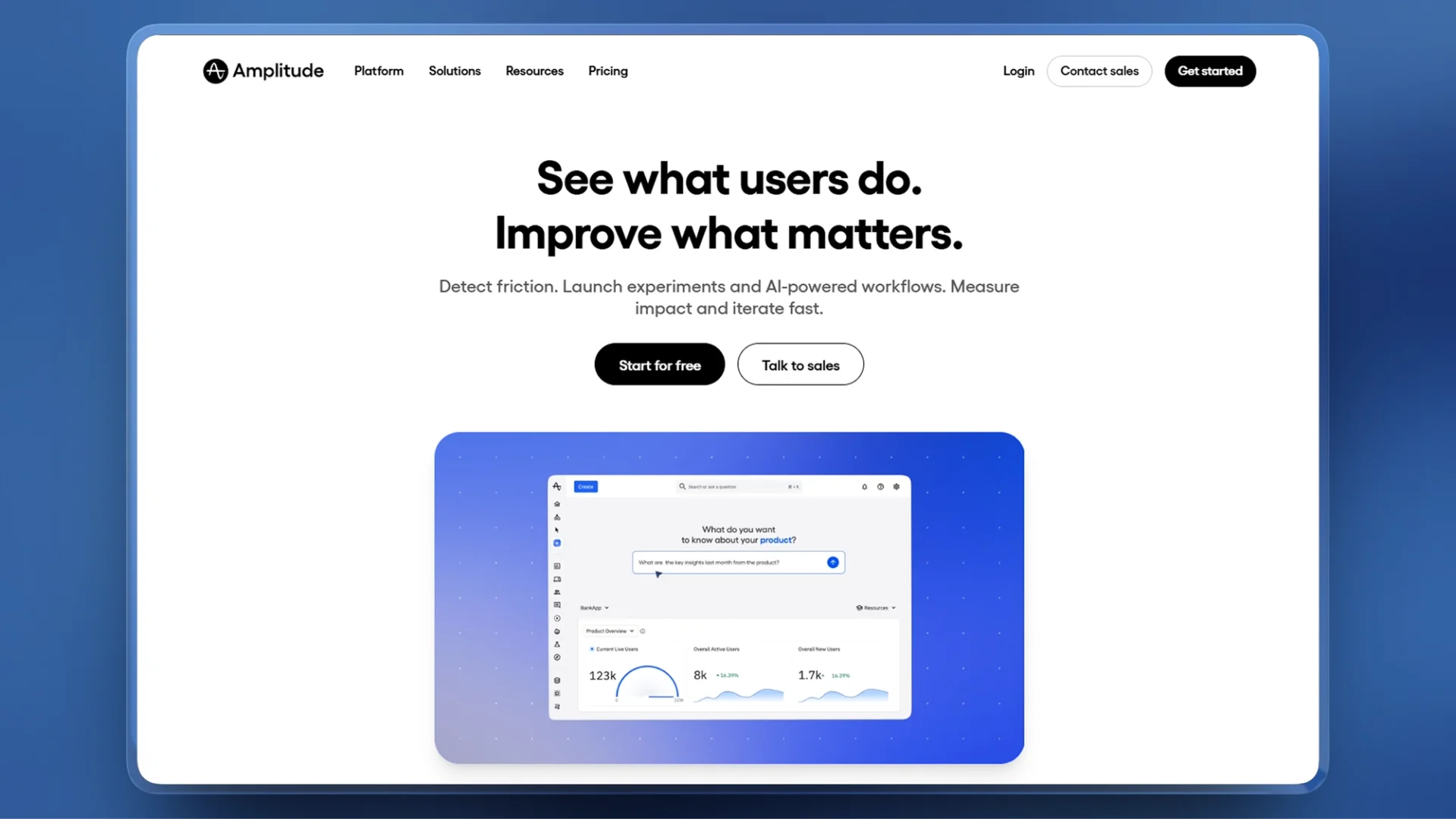
Amplitude, a publicly traded product analytics company, grew its organic search traffic from roughly 7,000 monthly visits in 2015 to over 150,000 by the mid-2020s through a decade-long content partnership and today the engine it built (now run entirely in-house) averages 200,000 organic visits a month. The growth came from three compounding levers: inventing and owning the "product analytics" category through SEO content, layering a self-serve product-led growth (PLG) motion on top of a sales-led business, and using its own analytics product to run its marketing. This case study breaks down exactly how, with sourced numbers, so B2B and AI SaaS founders can copy the playbook.
The category didn't exist. So Amplitude had to build the search demand it wanted to capture.
Amplitude launched in 2012 (as a spinout of a voice-texting app called Sonalight) into an analytics market that only knew how to talk about acquisition: traffic, funnels, conversion. Nobody was searching "product analytics" because the term, and the category of software behind it, didn't exist yet. Product teams had real problems (why do users churn, what does a healthy cohort curve look like, what does month-over-month growth actually tell you) but no shared vocabulary to search for solutions.
Amplitude's former Head of Marketing, Aditya Vempaty, has described the starting position bluntly: at the time, the industry conversation was almost entirely about acquisition, with retention barely discussed. So instead of competing for existing keywords, Amplitude built content around the questions product managers were already asking themselves internally, and used that content to hand them the language to name, and justify solving, a problem they couldn't previously articulate.
One example that became a flagship piece: reframing retention loss in financial terms, losing 80% of your daily active users in the first three days effectively means throwing away 80% of what you spent to acquire them. That single reframe turned a soft, qualitative problem ("engagement feels low") into a hard, board-level one (a dollar figure), and it became one of the pieces credited with putting retention on product teams' radar industry-wide.
Why this matters for AI SaaS founders: if you're building in a category that's genuinely new (agentic workflows, AI observability, LLM evaluation, etc.), you have the same opportunity Amplitude had in 2012, and the same problem. There's no existing search volume to "optimize" for. You have to manufacture the vocabulary first, and the content that ranks later. This is a fundamentally different SEO motion than competing on existing high-volume terms, and it's the single most defensible moat in organic marketing: once you own the definition of a category, you own the SERP.
The full-funnel content engine: three tiers, three jobs
Once the category vocabulary existed, Amplitude and Animalz scaled output from zero to three posts a week, each engineered for a specific stage of the buyer's journey and a specific job:
- TOFU (Top-of-Funnel): SEO-optimized posts targeting the long-tail, technical pain points product managers and growth marketers search for daily including cohort analysis, churn diagnosis, growth-rate math. This is where domain authority and rankings compound over years.
- MOFU (Middle-of-Funnel): Comprehensive resources like the Growth Marketing Guide, designed to capture emails and hold the attention of prospects who are actively evaluating solutions, not just researching a problem.
- BOFU (Bottom-of-Funnel): Data-heavy case studies built to withstand scrutiny from multi-stakeholder enterprise buying committees, where a single vague testimonial won't close a six-figure deal.
Over the following decade, that structure moved through distinct phases, according to Animalz's own account of the partnership: first inventing the category's vocabulary, then earning an audience beyond search rankings, then defending the compounding value of existing rankings as content aged, and eventually producing thought leadership credible enough to influence how enterprise buyers thought about the space.
One of the most important key points that deserves emphasis: defending rankings mattered as much as winning new ones. Content decays as search intent shifts and competitors publish fresher material. Animalz has noted that dropping from position 1 to 2 can cost roughly half a page's traffic, and falling further can wipe out the large majority of it. Amplitude's team didn't just publish and move on; they continuously refreshed and re-angled high-performing pieces that were losing ground, which is a large part of why traffic kept compounding instead of plateauing after year three or four.
Content also had a secondary job beyond SEO: earning distribution outside search entirely. Early in the partnership, Animalz produced culturally-timed pieces (one tied to a Beyoncé album drop) that spread through social sharing rather than search, and picked up unplanned amplification including a mention in an Inc. column about small businesses using Pokémon GO that went viral and drove a traffic spike to an Amplitude post. These weren't the growth engine itself, but they built the early credibility and backlink profile the SEO foundation needed to start compounding.
The operational detail worth: as output scaled, the team embedded another team member, Victoria, directly inside Amplitude's marketing org to manage day-to-day production and clear the coordination bottlenecks that come with more stakeholders and more content in flight. It worked well enough that Amplitude eventually hired her full-time. That's not a footnote, it's the actual mechanism by which the systems and institutional knowledge transferred from agency to in-house team, which is why the 150k number grew to 200k after the partnership formally ended rather than decaying.
Why this matters for your SEO strategy: if your agency's roadmap is 90% new content and 10% refreshes, you're leaving compounding value on the table. A mature organic program spends real, ongoing effort defending what already ranks, not just chasing new keywords.
Layering product-led growth on top of the content engine
Content built the top of the funnel. PLG is what converted and monetized it without a proportional increase in sales headcount.
From $20K-a-year sales-led deals to a $49/month self-serve tier
Amplitude spent its early years as a classic enterprise sales-led business, with deals starting north of $20,000 a year. The shift to PLG wasn't a sudden pivot, it was built on a free tier that had existed since 2015, which gave the company years of usage data before it ever launched a paid self-serve plan. When Amplitude did launch its $49/month self-serve "Plus" plan, it had already tested the offer with free users for over a year before general availability. Elena Verna, who served as Amplitude's interim Head of Growth during this period (and has since advised PLG motions at MongoDB, Netlify, and others), has pointed to this as a deliberate, evidence-led rollout rather than a growth-hack: real customer demand had been building for a cheaper entry point, and the free tier gave Amplitude the data to size and price it with confidence instead of guessing.
PQAs and PQLs: replacing cold outreach with product signal
Rather than routing every free sign-up to a sales rep, Amplitude segments self-serve usage into two distinct signals:
- Product Qualified Accounts (PQAs): an account-level score based on usage volume, velocity, and behavior, indicating an account is ready to be engaged by sales. This tells you when.
- Product Qualified Leads (PQLs): identifying whether an actual economic buyer (budget owner, decision-maker) exists inside that engaged account. This tells you who.
The distinction matters because a PQA without a PQL is a dead end for sales, you have an engaged team with no one who can sign a contract. Their framework for handling this gap: use onboarding profiling (a short quiz at sign-up) to surface buyer-persona data directly, rather than relying on sales development reps to guess. This is the mechanism that let Amplitude expand from individual product managers using a free tool to six-figure enterprise contracts, without cold outbound doing the heavy lifting.
Virality inside the org, not just outside it
Because Amplitude's product produces shareable artifacts like dashboards, cohort charts, reports usage inside one team naturally surfaces the tool to adjacent teams and departments who see a colleague's chart and want their own. This is a distribution loop that costs nothing in paid spend and compounds with every new internal user, functioning as internal virality rather than the classic invite-a-friend viral loop most PLG playbooks describe.
Using Amplitude to run Amplitude's marketing
The final layer and the one most competitors can't easily copy is that Amplitude's internal growth and marketing teams use the product itself to run behavioral, cohort-based marketing:
- Cohort segmentation: sign-ups are split into persona cohorts based on actual behavior, not self-reported job titles.
- Triggered in-product education: if a user signs up but never creates a report (a leading indicator of churn), an automated, contextual nudge fires inside the product.
- Contextual over broadcast: feature announcements, surveys, and tips are served based on what a user is or isn't doing live in the app, rather than blasted to the entire list.
- Unified marketing + product attribution: marketing teams trace exactly which blog posts, campaigns, or landing pages hooked the users who went on to become the highest lifetime-value customers thus closing the loop between top-of-funnel content and long-term revenue, instead of stopping measurement at "sign-up."
This is the compounding advantage of being an analytics company: every other lever in this case study (content, PLG, PQL scoring) runs through Amplitude's own product, which means the marketing team's tooling improves every time the core product improves.
The Flagship Asset: Turning an Internal Framework Into a Linkable, Lead-Generating Product
One of the most underrated pieces of Amplitude's growth strategy isn't a blog post at all, it's the North Star Framework, a product-strategy methodology Amplitude built internally and then turned into a public content property: a dedicated microsite, a downloadable playbook, live workshops run "across the globe," and a steady stream of blog posts explaining how to apply it.
This matters for three reasons:
- It's genuinely earned, not manufactured. Amplitude didn't invent the North Star Framework as a marketing exercise. They built it to run their own product org, reportedly helping drive more than 4x growth in their own user base over two years and only then packaged it for external audiences. The authenticity is what made it linkable: writers, product leaders, and other companies cite it because it's a real operating model, not a gated ebook with no substance behind it.
- It compounds as a backlink magnet. Because the framework has become a reference point across the product management industry, cited by other companies, taught in workshops, and referenced in unrelated third-party articles it pulls in backlinks that a normal blog post never could. That's a direct SEO asset, not just a brand play.
- It doubles as a qualification tool. Anyone deep enough into the North Star content to attend a workshop or download the playbook is, almost by definition, the exact buyer persona Amplitude sells to: someone responsible for product strategy and metrics.
Why this matters for your growth strategy: the highest-leverage content asset a B2B or AI SaaS company can build usually isn't a listicle, it's a genuine internal framework, model, or methodology you already use, repackaged as a free public resource. It's harder to produce than a blog post, but it earns links and trust that content calendars alone can't buy.
The Glossary: Programmatic SEO for the Terms You're Trying to Own
Alongside long-form content, Amplitude maintains a dedicated glossary hub covering terms across analytics, product, and growth and things like "product-led growth," "cohort analysis," or "activation rate." Each term gets its own indexable page with a clear, standalone definition.
This is a classic and still highly effective programmatic SEO play, and it does double duty for a company in category-creation mode:
- It captures top-of-funnel, definitional search queries ("what is PLG") that a competitor with only bottom-of-funnel content will miss entirely.
- It reinforces category ownership, if Amplitude is the source that defines the terminology of "product analytics," it becomes the reference point other sites link to when explaining the same concept.
- Glossary pages are cheap to produce at scale relative to a 2,500-word guide, which makes them an efficient way to build topical authority around a category before investing in heavier content.
Why this matters for your SEO strategy: if you're building a category (which most AI SaaS companies currently are), a glossary isn't an afterthought. It's often the fastest way to start ranking for the vocabulary your buyers are searching for, before you've built out deeper funnel content.
The Integration Ecosystem as a Programmatic SEO and Backlink Engine
Amplitude has built out a partner and integrations ecosystem well beyond what most SaaS companies treat as a footnote page. With well over 130 listed integrations spanning attribution platforms, CDPs, engagement tools, CMSs, and more, each integration typically gets its own dedicated landing page describing the use case and setup.
The growth mechanics here are easy to underestimate:
- Every integration page is a long-tail SEO page targeting a very specific, high-intent query pattern: "[Partner] + Amplitude integration." These pages rank because the intent is narrow and the competition is close to zero.
- Every partner is a built-in backlink and co-marketing source. Partners like HubSpot, Braze, Contentful, and dozens of smaller tools link back to Amplitude from their own integration or app marketplace pages, and often publish their own blog content about the joint use case as seen with partners like MoEngage publishing entire recap posts about Amplitude's conference and partnership.
- The Amplitude Partner Program formalizes this into a repeatable channel, offering partners co-funded marketing resources, joint sales motions, and training through "Amplitude Academy" turning what could be a one-off integration listing into an ongoing stream of co-marketing content and links.
Key insight: if your product has any integrations at all, each one is a legitimate, low-competition SEO page waiting to be built, and a relationship you can turn into a backlink and content-sharing arrangement, not just a technical connector.
The Business Results
- Revenue growth: Amplitude's former Head of Marketing has credited the content-led demand generation program with driving 400% revenue growth during his tenure. Company-wide, disclosed revenue grew from $167.3M (FY2021) to $299.3M (FY2024).
- Category ownership: Amplitude became the reference name in "product analytics," a term it helped popularize, and ranked #1 for adjacent terms like "mobile analytics."
- Public markets validation: Amplitude went public via a direct listing on the Nasdaq (ticker AMPL) on September 28, 2021, opening at $50 a share and closing its first day at a roughly $7.1 billion fully diluted valuation, a route CEO Spenser Skates chose specifically to avoid the systematic underpricing common to traditional IPOs.
- A Harvard Business School reading list placement:a piece was co-written with Elena Verna, "Not All B2B Companies Should Be Doing Product-Led Growth," was added to HBS's recommended reading which is a rare example of B2B content earning academic-tier distribution, not just search rankings.
The Mistake Most SaaS Companies Make
By this point, a pattern should be obvious: Amplitude didn't grow to 200,000 monthly organic visits by publishing blog posts alone. It built an ecosystem of acquisition assets that compounded for years.
That's where many SaaS companies get stuck.
Most launch on Webflow, Framer, or WordPress. They're excellent for shipping landing pages, publishing blogs, and validating an early product. But they become increasingly limiting once organic growth depends on building products rather than pages.
Amplitude's website wasn't simply a content hub. It became a collection of interconnected growth levers.
Its glossary captured high-volume educational searches. The North Star Framework became a link-worthy industry resource. Integration pages created hundreds of high-intent SEO opportunities. Product-led growth converted readers into users. Every asset strengthened the others.
The same pattern exists across today's category leaders.
Companies like ClickUp, Zapier, Notion, Miro, Canva, Cloudflare, and n8n don't rely solely on landing pages or blog content. They build scalable growth assets such as:
- Template libraries
- Integration directories
- Migration pages
- Comparison pages
- Workflow libraries
- Glossaries
- Interactive calculators
- Free AI tools
- Programmatic SEO pages
- Product-led utilities that generate organic demand
Each becomes a compounding acquisition channel. Instead of relying on another blog post every week, these companies ship assets that continue attracting traffic, backlinks, AI citations, shares, and qualified users for years.
Amplitude's glossary is a perfect example. Its integration directory is another. The North Star Framework evolved from an internal operating model into an industry-standard resource that earned links, educated buyers, and reinforced category authority simultaneously.
This is also why many of today's fastest-growing SaaS companies eventually move beyond traditional website builders. Platforms like WordPress, Webflow, and Framer are excellent CMSs for marketing websites, but they weren't designed to support engineering-led growth systems at scale.
Modern SaaS companies increasingly combine frameworks like Next.js, Astro, or Nuxt with headless CMS platforms such as Sanity, Payload CMS, Strapi, Directus, or DatoCMS. That architecture gives engineering, product, growth, and SEO teams the flexibility to build interactive acquisition assets that simply aren't practical on traditional no-code platforms.
The lesson isn't that Webflow, Framer, or WordPress are bad products. They're excellent at what they were built to do.
The mistake is assuming a marketing website is the same thing as an organic growth engine.
Amplitude didn't win because it published more articles than its competitors. It won because it built assets competitors couldn't easily replicate. Its glossary, North Star Framework, integration ecosystem, PLG motion, and category-defining educational content all became durable growth levers that reinforced one another.
The biggest organic growth opportunities rarely come from another landing page. They come from building products, frameworks, tools, and resources that continue generating demand long after they're published.
The playbook, condensed for B2B and AI SaaS founders
If you're a B2B or AI SaaS founder trying to translate this into your own roadmap, the transferable principles are:
- Treat organic as a decade-long asset, not a quarterly campaign. Amplitude's growth from 7,000 to 150,000+ monthly visits took nearly ten years of consistent investment and refresh cycles, not a single viral post.
- Structure content deliberately across TOFU, MOFU, and BOFU instead of publishing everything at the same depth and hoping some of it converts.
- Spend real effort defending existing rankings, not just producing new pages, content decay is real and it's often cheaper to refresh than to build new.
- If you don't have a category yet, build the vocabulary first. Write for the problem your buyers already have, even before search volume exists for your specific solution, a glossary is often the fastest, cheapest way to start.
- Connect content and product data. The strongest MOFU and BOFU content is written by people who can see what actually happens after a signup, not just what ranks.
- Build one real flagship asset from something you already know. An internal framework, methodology, or playbook you use to run your own team is a far stronger linkable asset than a generic ebook, because it's genuinely earned rather than manufactured for marketing.
- Treat every integration as an SEO page and a relationship, not just a technical listing. Low-competition, high-intent "[partner] + [your product]" pages compound quietly over time, and each partner is a potential co-marketing and backlink source.
- Don't underestimate a flagship event or community property. Recaps, speaker networks, and evergreen session content generate the kind of editorially earned backlinks that outreach campaigns struggle to replicate.
Conclusion
Amplitude's organic growth story isn't a single tactic worth copying, it's a system of compounding assets that reinforced each other over a decade. The content engine built category-defining vocabulary that didn't exist before Amplitude needed it. The PLG motion turned that traffic into product usage without a proportional sales team. The product itself became the marketing team's own analytics tool, closing the loop between content and revenue. And a set of supporting assets like a glossary, a flagship framework, an integrations ecosystem, an annual conference; each generated their own independent stream of backlinks and search visibility, so the whole engine kept compounding even after the original agency partnership ended.
For a B2B or AI SaaS founder, the takeaway isn't "hire a content agency and wait ten years." It's that organic growth at this scale is built from several distinct, mutually reinforcing systems having hardest-to-copy moves (owning a category's vocabulary, building a real flagship asset from something you already know how to do) are also the ones that pay off longest. Amplitude's numbers took a decade to compound. The playbook for getting there is available today.